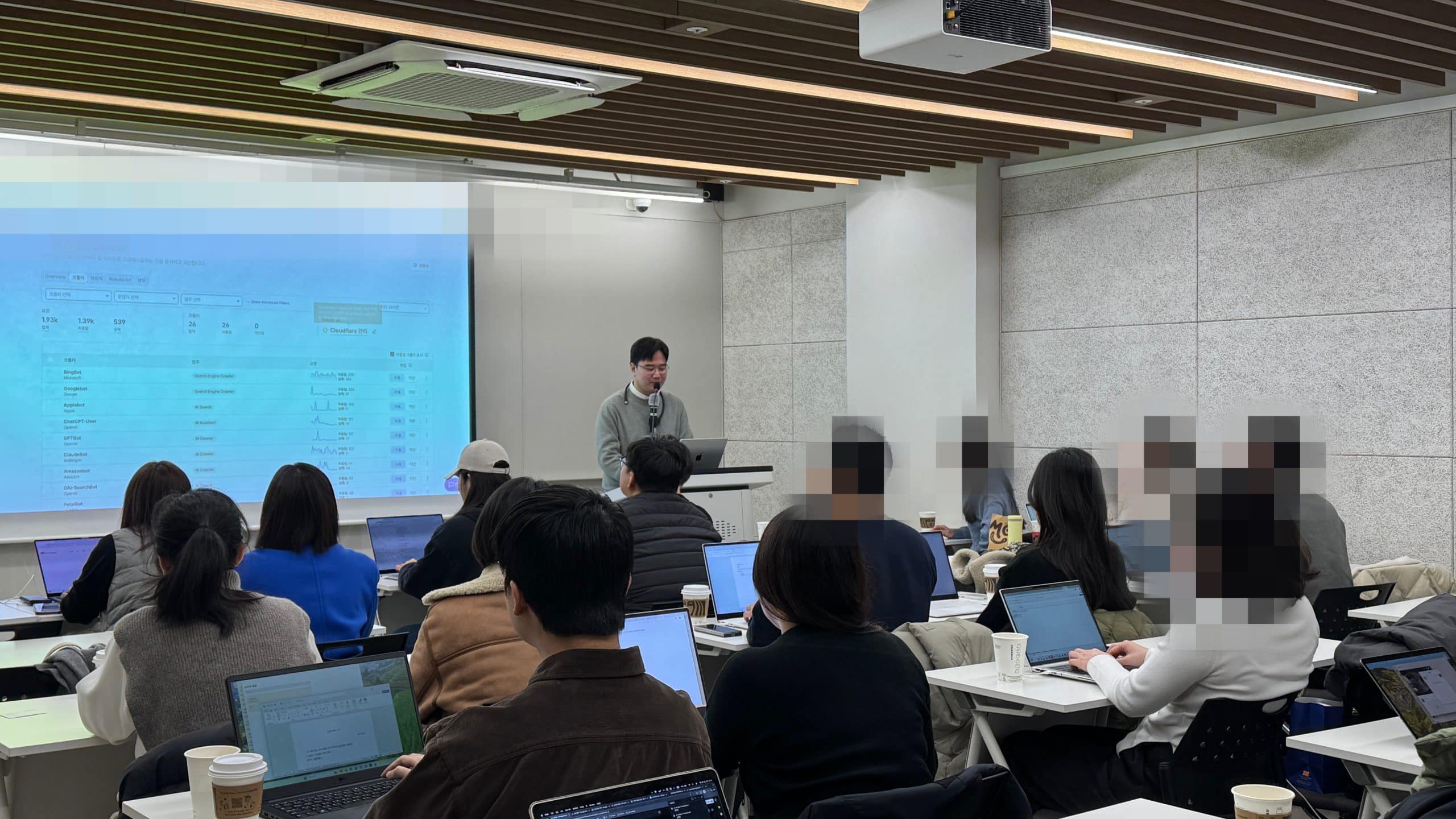
Practical Lecture on AI Search Visibility Optimization (Korea International Trade Association)
GEO (Generative Engine Optimization) is a strategy, not just a technology.
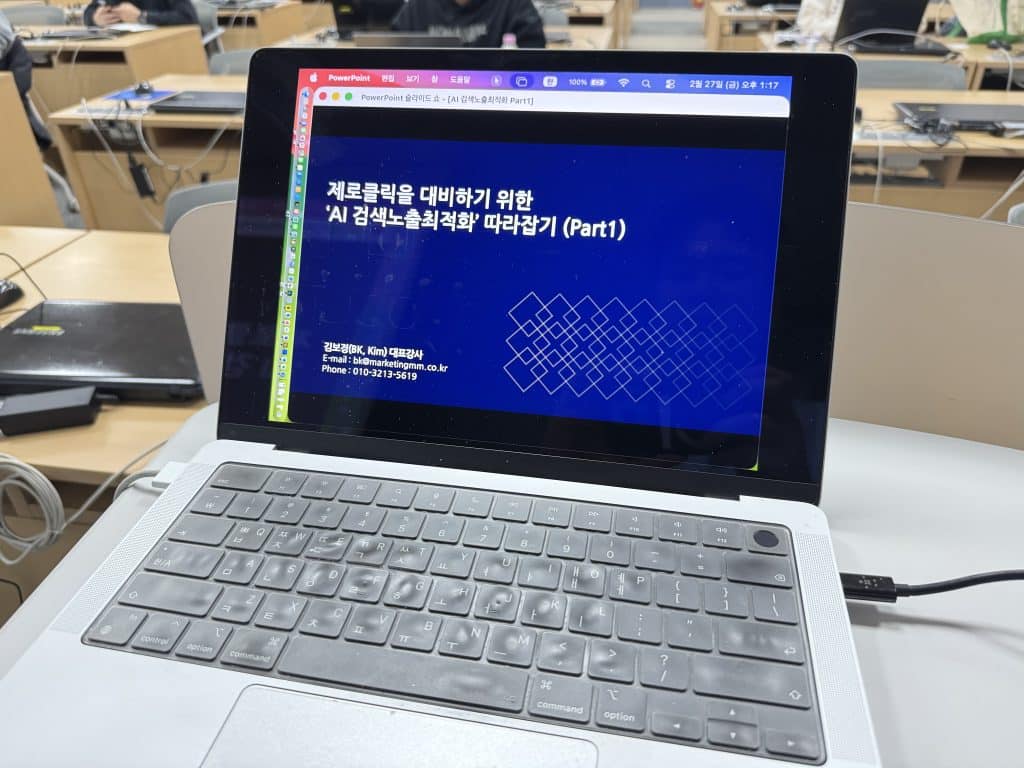
Held on February 27, 2026, at the Korea International Trade Association (KITA), this practical lecture was more than just an introduction to theory. It was a session where field-proven strategies were revealed one by one.
Many people are asking these questions lately.
“They say the era of AI search is here—is GEO all I need?”
“Can I rank at the top just by writing good prompts?”
The core message of this lecture was clear.
1. GEO is an ‘Expansion Pack’ built on top of SEO
AI Search Visibility Optimization (GEO) is not a replacement for traditional SEO. Data supports this, showing that content appearing on the first page of Google has a more than 50% chance of being cited by GPT.
To summarize:
– SEO is the foundation,
– GEO is the expansion on top of it, and
– AI Citation is the result.
Trying to do GEO without basic SEO is like trying to run a marathon without any physical conditioning.
2. AI traffic is low in volume, but the ‘quality’ is different
The section where I shared actual dashboards during the lecture received a particularly positive response.
AI traffic currently accounts for less than 5% of total inflows.
However, the average session duration for users coming through GPT was over 6 minutes.
Considering that the average session duration for general search traffic is around 60 seconds and the average time to add an item to a cart in e-commerce is about 2 minutes and 30 seconds, traffic from AI can be seen as traffic with a significantly higher potential for purchase conversion.
Low volume, but overwhelmingly high quality. This is exactly why you need to start preparing for AI search optimization now.
3. The key to Global SEO is ‘Market Selection’
While the domestic market has a population of 50 million, the English-speaking market reaches 1 to 1.5 billion people.
Global SEO is not just a translation task.
Global companies do not go all-in on an SEO strategy for a single country.
They test North America, Southeast Asia, and Europe with the same budget and then invest heavily in markets with the fastest ROI.
This approach is the biggest difference compared to Korean companies.
4. Success Stories
The strategy revealed in the case study was surprisingly simple.
1. Competitor analysis
2. Inbound keyword extraction
3. Prioritization
4. Mass publishing of programmatic content
5. 3 months of focused execution
As a result, international inquiries increased tenfold.
The key was data, not intuition.
5. Industries where AI Search Optimization delivers fast results
Based on current observations, the status of AI-driven traffic by industry is as follows.
| Industry | AI Traffic Level |
|---|---|
| Plastic Surgery / Dental | AI traffic already occurring |
| Healthcare / Manufacturing | Around 20% |
| New Drugs / Robotics / AI / Solar Power | Over 40% |
The more time-sensitive the industry, the faster the proportion of AI citations tends to increase.
6. Two reasons why SEO fails
At the end of the lecture, I gave some realistic advice to the participants.
First is impatience.
SEO is a structural battle that requires a perspective of at least 6 months to a year.
If you expect short-term results, it’s easy to give up halfway.
Second is the lack of infrastructure.
If a domain is less than a year old, the probability of ranking at the top is only about 4%.
The gap between companies starting from zero and those with existing infrastructure is more overwhelming than you might think.
7. So, what should we do?
AI Search Visibility Optimization is not a passing fad.
The search ecosystem is evolving.
What we need to do now is clear:
1) Build a solid SEO foundation,
2) Design structured content,
3) Test global markets, and
4) Systematically build an AI citation structure.
This is a true GEO strategy.
If you need a lecture related to GEO and SEO, please contact m3company.