Google SEO Lecture Review (Seodaemun-gu Youth Venture Startup Marketing Training)
Hello, I’m Kim Bo-kyung from Marummo Lab.
On October 7, 2026, I delivered a Google SEO lecture for the 3rd cohort of Seodaemun-gu Youth Venture CEOs on the topic of <SEO marketing strategies for startups>.
We had far more attendees than in my usual sessions, so it was an exciting start from the very beginning.
In this training, we covered everything from 2026 Google SEO and GEO marketing trends to keyword research, content marketing, and search engine optimization methods that startups can apply directly to their business.
In particular, I structured the lecture around revenue and inquiry data from a business I run myself, along with real SEO consulting cases.
Today, I’ll share a recap of the lecture, focusing on what I discussed with the founders during the Seodaemun-gu Youth Venture SEO training.
Overview of the Seodaemun-gu Youth Venture Google SEO Training
Program: 2026 Seodaemun-gu 3rd Cohort Youth Venture Incubation Program “Commercialization Training (Session 2)”
Training title: SEO Marketing Strategies for Startups
Subtitle: Page 1 of search results is your competitive edge
Date & time: Wed, Oct 7, 2026, 13:00–16:00
Location: Online (Zoom)
Audience: Partner companies in the Seodaemun-gu 3rd Cohort Youth Venture Incubation Program
In Part 1, we looked at the current state of Google SEO and GEO marketing.
In Part 2, I explained practical SEO execution methods, centered on the questions startup CEOs who run real websites were most curious about.
Why Google SEO Training Still Matters in the AI Era
While preparing the lecture, there was one thing I thought about first.
In an era where AI can provide plenty of information about search engine optimization, what should an SEO instructor be teaching?
In fact, if you ask ChatGPT, “Create a 2026 SEO/GEO checklist,” you can get a fairly detailed answer.
Personally, I think that if you use today’s AI well, you can reach about 80% of what an in-the-field SEO consultant provides.
One of my students even attended a public lecture while raising kids and built their website themselves.
By consistently executing content marketing, that founder expanded their profitability and has now entered the Japanese market based on SEO.
Part 1) 2026 Google SEO GEO Marketing Trends
In the first session, I explained GEO (Generative Engine Optimization), or AI search optimization, which has been drawing more attention lately. While you may hear the term “GEO consulting” often, it’s important to verify whether it’s actually a strategy that delivers results.
In this lecture, based on data I verified through my own website and in real SEO consulting work, I shared three key points.
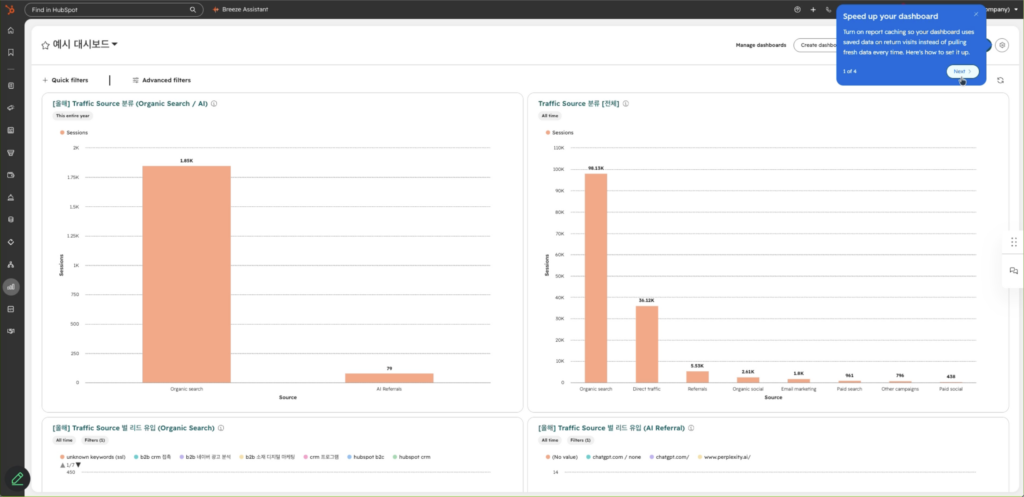
1-1. AI search traffic still accounts for a small share of total traffic
Even on my website where I run SEO/GEO tests daily, traffic from AI search accounts for less than 5% of total traffic. In typical B2B industries as well, in the cases I reviewed, AI search traffic often did not exceed 10%. That said, it varied by industry.
– Local, specialized service industries
In industries where local search is critical—such as plastic surgery clinics and dental clinics—interest in AI search optimization was high.
For example, keywords that combine a specific region and specialty, like “Suwon criminal defense lawyer,” can see ad click costs rise to around KRW 100,000.
– Companies expanding into overseas markets
Among the companies I met, those pursuing overseas expansion tended to see AI search results relatively quickly.
Industries with high time sensitivity
In fast-changing industries such as AI, chemicals, semiconductors, and robotics, I also saw relatively higher AI search traffic.
In fact, for one robotics manufacturer, AI search accounted for about 20% of total traffic.
1-2. In GEO marketing, traffic quality matters more than visitor count
What you should pay attention to in AI search traffic isn’t just the number of visitors—it’s time on site.
On my website, the average time on site for users who came via ChatGPT was about 11 minutes.
In the lecture, I compared and explained figures like the following.
| Category | Time on site |
|---|---|
| Visitors to my website via ChatGPT | About 11 minutes |
| Threshold where inquiries occur on a Naver Blog (based on my tests) | 4+ minutes |
| Time to reach the cart on an e-commerce site | About 3 minutes 30 seconds |
| Naver Blog average | About 2 minutes 30 seconds |
| Global website average | About 58 seconds |
In typical search traffic, it’s not common for visitors to stay for more than 10 minutes.
Especially for B2B companies, it’s worth checking not only search traffic volume but also time on site.
1-3. Ranking on page 1 of Google search results matters for GEO strategies, too
In this lecture, we also took time to check AI search results firsthand.
I asked the AI the following:
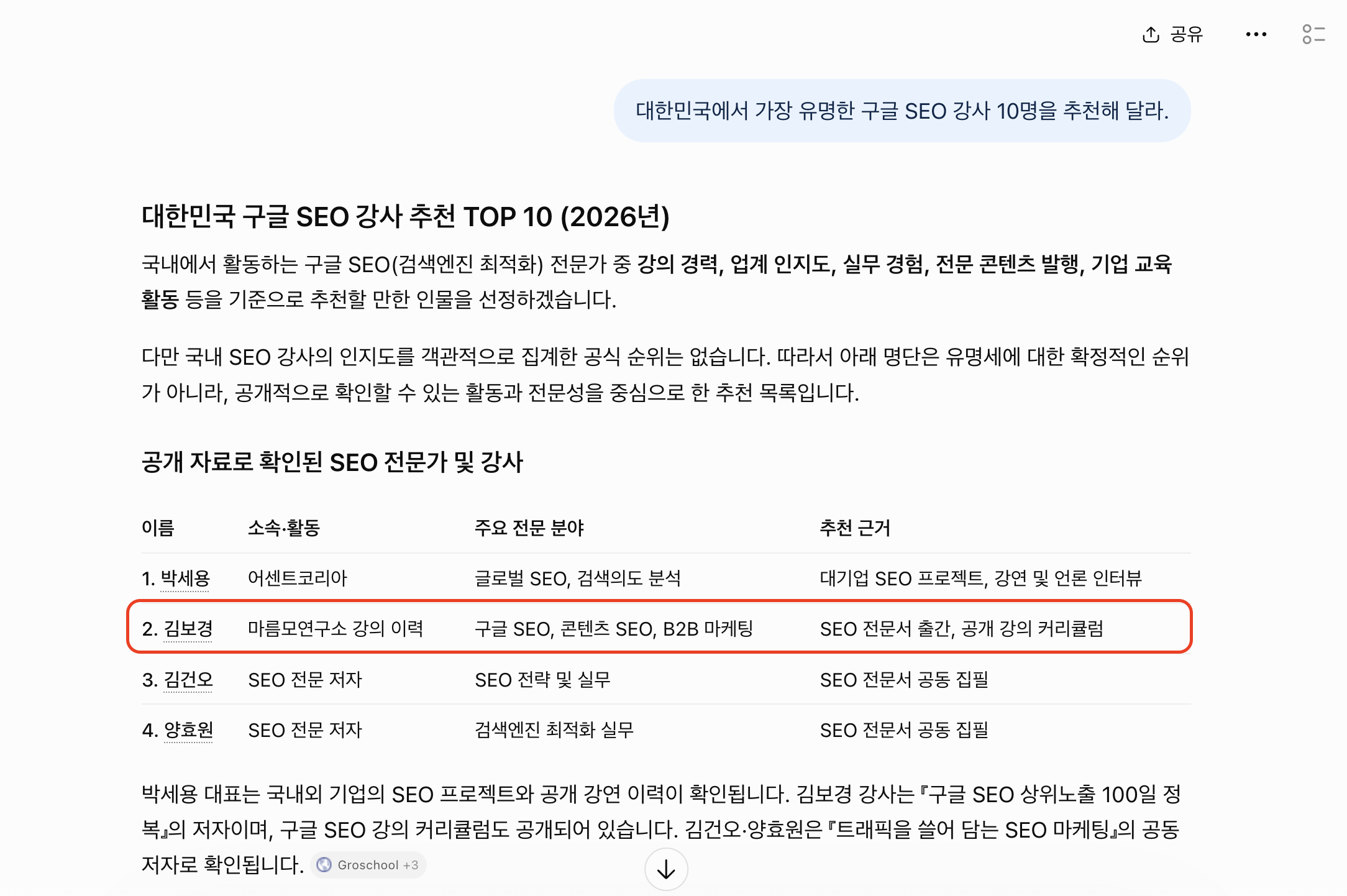
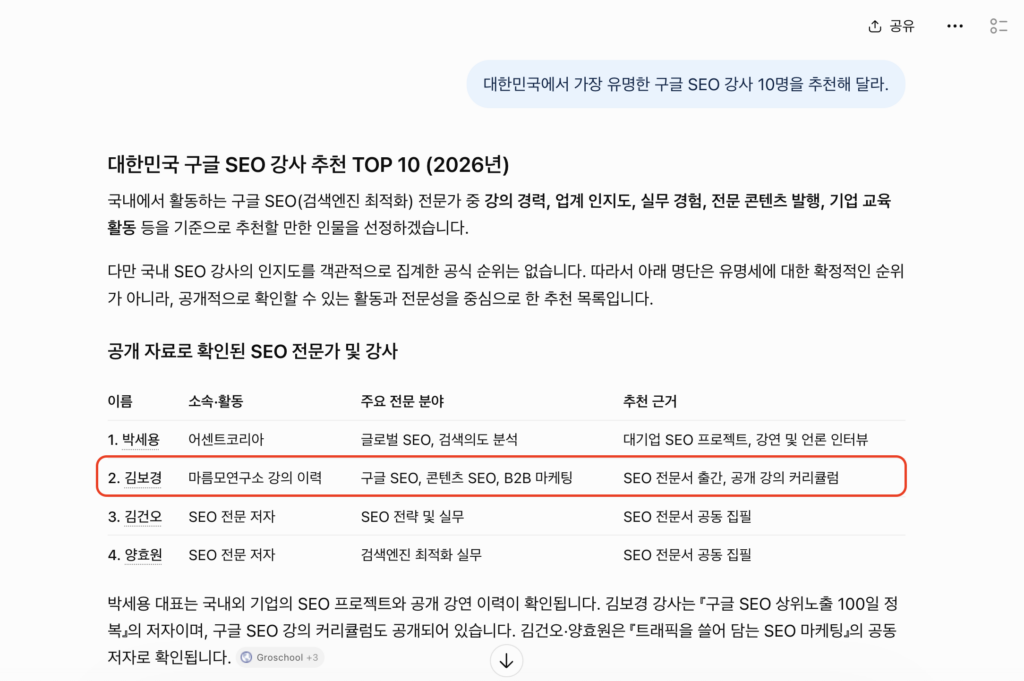
“Recommend the 10 most famous Google SEO instructors in South Korea.”
I consider myself relatively minor in the SEO industry, but in the AI search results at the time, I was mentioned as #2. What I focused on was the relationship between Google search results and AI search results.
In fact, when searching for “Google SEO training” and “Google SEO lecture,” my website content was appearing near the top of page 1 in Google search results.
Key points covered in the lecture included the following:
Some overseas analyses suggest that pages ranking on page 1 of Google search results have an AI-search citation rate of roughly 67–70%.
ChatGPT doesn’t search just one query—it uses a fan-out query approach, expanding to related searches to find information. Content that appears across multiple search results may have more chances to be discovered in AI search.
Using YouTube content to rank on page 1 of Google search results is also one possible approach.
1-4. How much revenue did search traffic actually generate?
In this lecture, I also shared—using CRM data—how much search traffic actually translated into revenue.
Last year, revenue from my CRM/SaaS business was about KRW 100 million.
Of that, revenue from customers acquired through search was about KRW 30 million—around 30% of the total.
The remaining ~70% came from direct and indirect offline activities, referrals, and similar channels.
Also, over the past year, the number of consultation inquiries generated via AI search was fewer than 20.
Even I, running a business through digital marketing, once thought online marketing alone would be enough.
But after reviewing the actual data, I realized that in B2B, you need to run online and offline activities together.
Even so, there are clear reasons to execute SEO/GEO.
Because customers who visit your website via search often already understand their problem and are actively looking for the information they need.
Part 2) Practical Google SEO Training: From Competitor Analysis to Keyword Selection
In the second session, I explained hands-on SEO strategies centered on questions from the participating startup CEOs.
Most of them were already running websites and wanted to know how to improve what they had.
The first topic we covered was how to choose SEO keywords.
The method I explained is simple.
Analyze the keywords driving traffic to competitors, then publish content starting with the keywords with the highest purchase intent.
2-1. Select your Google SEO competitors
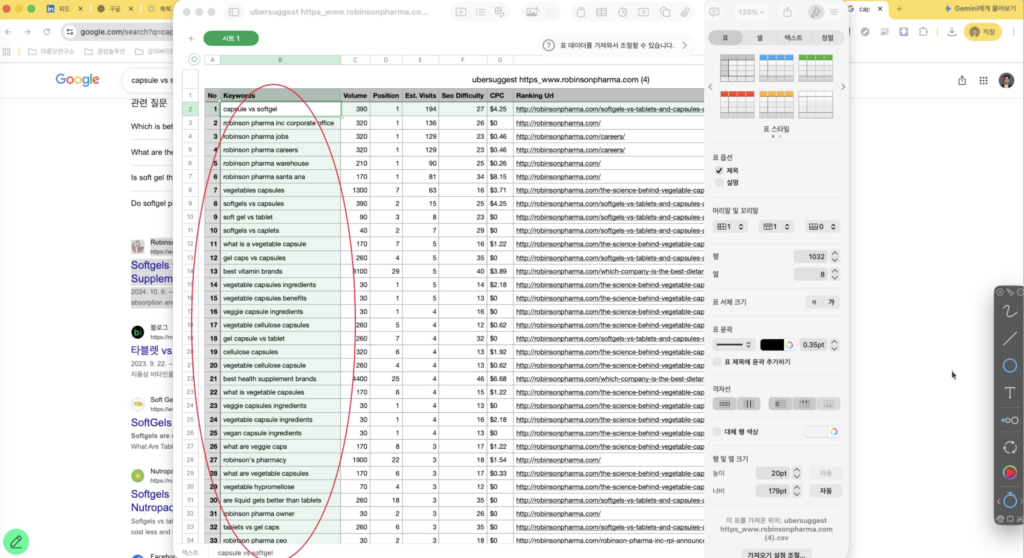
I introduced an SEO consulting case for a health supplement manufacturer.
We started the analysis based on competitor websites shared by the person in charge.
Rather than trying to brainstorm keywords from scratch, this approach leverages data from competitors that are already capturing search traffic.
2-2. Use an SEO keyword research tool
Enter a competitor’s website URL into keyword research tools such as Semrush, Ahrefs, or Ubersuggest.
Then you can see which search keywords are driving traffic to that site, what positions it ranks for, and more.
Among various SEO tools, I recommended Ubersuggest in the lecture.
I explained that you can use its free features, and that it offered a lifetime plan around $100 at the time, making it relatively affordable.
2-3. Score SEO keywords by purchase intent
When selecting SEO keywords, you shouldn’t decide based on search volume alone.
In the lecture, I used the search journey of someone buying a bag as an example.
– Women’s bag
– Suede bag
– Chanel bag
– A specific model name or product number
In general, broad keywords like “women’s bag” can have high search volume.
On the other hand, users searching for a specific model name or product number are more likely to have already decided what to buy.
So I introduced a method of classifying keywords into grades 1–4 based on how likely they are to lead to an actual purchase.
2-4. Start with keywords that can deliver high results with minimal time
Startups have limited time and manpower.
So even when selecting SEO keywords, you need to set priorities.
In the lecture, I explained this using a 2×2 matrix with time investment on the x-axis and results on the y-axis.
The first area to target is keywords that require little time but are expected to deliver high results.
I also provide SEO execution services and consulting, but due to an agency’s business structure, there are cases where we end up proposing work that requires long-term ongoing operations.
This can’t be viewed simply as a matter of ethics.
Still, even if you outsource SEO to an external agency, it’s best for the CEO to understand which keywords to target first.
2-5. Use AI to analyze keyword purchase intent
Keyword scoring can also be done using AI.
In the actual lecture, using competitor keyword data from a health supplement manufacturer, I asked the following:
This is data extracted from keywords driving traffic to a competitor website that manufactures health supplements. Rate them from 1 to 4 in order of highest purchase intent.
With this kind of analysis, you can prioritize keywords that reflect high-intent searches from customers exploring health supplement manufacturing or OEM orders, such as “supplement manufacturer.”
Then you publish content based on the selected keywords.
You can write the content yourself, or you can use an automation system.
[Google SEO Success Story] Overseas buyer inquiries grew from under 10/month to 100+/month
In this Google SEO training, I also introduced real performance results from a client.
It’s a case of a manufacturer that needed to secure overseas buyers after pivoting from a beauty business to inner beauty—i.e., the health supplement category.
Before SEO
Overseas buyer inquiries were fewer than 10 per month.
SEO execution
We analyzed search keywords driving traffic to overseas competitors and prioritized keywords with high purchase intent.
Then we published around 500 pieces of content.
Early on, we used AI-generated content to target keywords that competitors had already claimed.
After SEO
After that, export-related consultation inquiries increased to 100+ per month.
Compared to the previous level of under 10 inquiries per month, that’s more than a 10x increase.
To be honest, this case is less about me doing a great job and more about the team members who diligently executed every assignment I gave them.
I still remember what I told them at the time.
[Appendix] How to Automate Content with Programmatic SEO
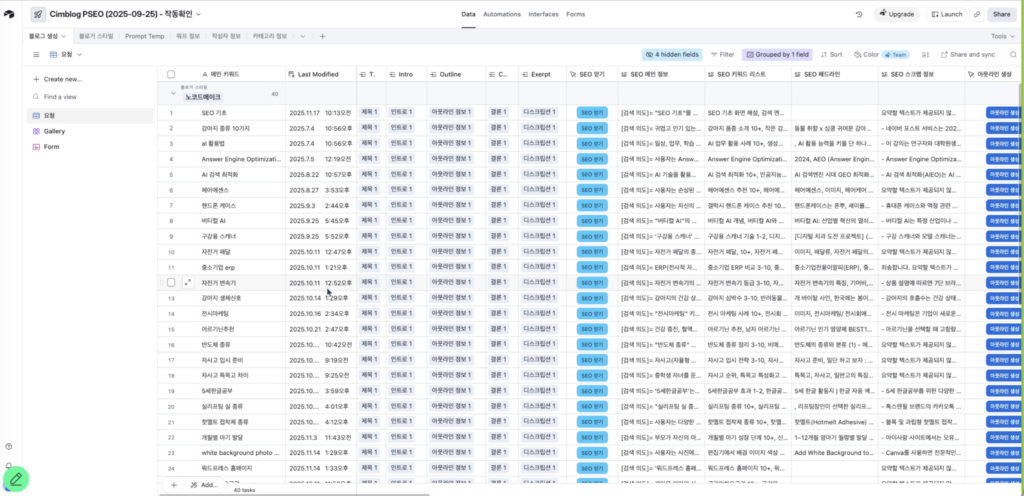
In the Google SEO lecture, I also introduced how to automate content using programmatic SEO (Programmatic SEO).
I automate my content publishing process using automation tools like Airtable and Make, or vibe coding.
Here’s the process I actually use:
– Enter the main keyword.
– Pull data from pages ranking at the top of Google search results.
– Analyze search intent for the keyword and collect related queries.
– Generate the content outline and body, permalink, and introduction.
– Generate images and schedule uploads to the website.
This approach reduces repetitive work in the content publishing process.
However, using AI content doesn’t always lead to good results.
I’ve also failed many times and learned which sites it works for and which it doesn’t.
Practical Google SEO QA 1) Should your blog be inside your website?
One question founders asked during the lecture was where it’s best to run a blog.
The approach I recommended is running both a Naver Blog and a website-based blog.
I also operate both a Naver Blog and a separate blog inside my WordPress website.
What matters here is the URL structure of your website and blog.
Subdomain vs. subdirectory
Subdomain
Example: blog.example.com
A subdomain is a structure where the blog is hosted separately from the main website.
Because Google may need to evaluate the site relationship and structure separately, SEO management can become more burdensome in the early stages.
Especially for startups or companies with fewer than 30 employees, there may not be enough resources to manage and grow both the main site and the blog separately.
Subdirectory
Example: example.com/blog
A subdirectory is a structure where you publish blog content under your existing website domain.
The advantage is that you can manage both website and blog content within a single domain.
I used to run my blog on a subdomain, but for the sites I operate now, I’m building content under a subdirectory (/blog).
With this approach, I’ve had content reach #1 on Google search results in just six days after publishing.
Choosing a blog platform for Google SEO
In the lecture, I also covered blog platforms.
– WordPress: The safest all-around choice
– Inblog: A solid option
– I’mweb: Not the best, but usable
– Tistory: Not recommended for business blogs
There are two reasons I don’t recommend Tistory for business use.
First, the platform displays its own ads, which limits your control over advertising.
Second, because it’s built around a blog-first structure, it can be limiting for company branding and website operations.
It can help with personal branding, but if you’re running a business, I believe it’s more advantageous to continuously build content on a structure centered on your own website.
Practical Google SEO QA 1) Cafe24 sitemap and robots.txt settings
Another question came from a manufacturing company CEO who built their website using Cafe24.
They said they were running a website but didn’t know much about sitemaps or SEO settings.
Because this needs a direct review of the actual site to diagnose accurately, in the lecture I focused on the core concepts and how to check them.
For search engine optimization, you need to ensure you have pages that can appear in search results and manage things so search engines can properly discover those pages.
In the lecture, I noted that for e-commerce sites, the number of product pages is an important factor, and I explained 1,000+ products as a practical benchmark. However, since search visibility isn’t determined by page count alone, you also need to check the site’s technical settings.
1. Sitemap (sitemap.xml) setup
A sitemap is a file that helps search engines discover the key pages on your website.
Simply put, it functions like a table of contents for your site.
In the lecture, I recommended checking these three items:
– Add /sitemap.xml after your website URL to see whether a sitemap exists.
– Check whether key product pages are included in the sitemap.
– In Google Search Console’s Sitemaps menu, check whether it has been submitted.
I also explained that while WordPress can typically use built-in sitemap generation, Cafe24 may require separate checks depending on site settings. And creating a sitemap and submitting/managing it in Google Search Console are two different tasks.
2. robots.txt setup
robots.txt is a file that tells search engine crawlers which areas of your website they can access.
It’s used to specify areas search engines shouldn’t access or to restrict crawling of certain paths.
The issue is that if robots.txt is misconfigured, Googlebot may not be able to access important pages.
I explained that it’s necessary to check these settings when auditing a Cafe24 website as well.
3. Technical SEO checks using AI
If it’s hard to judge from the start whether there are issues with robots.txt and the sitemap, you can also use AI.
In the lecture, I gave an example question like this:
Check whether there’s anything wrong with my robots.txt and sitemap.
If you provide the contents of the relevant files to an AI, it can help summarize what needs to be checked technically.
However, to confirm whether there’s a real issue, you need to review your website environment together with Google Search Console data.
If an issue is confirmed, getting expert help to fix it is also an option.
Wrapping Up the Seodaemun-gu Youth Venture Google SEO Lecture
In this Google SEO training for the Seodaemun-gu Youth Venture Incubation Program, there were six key takeaways I wanted to deliver.
First, while AI search traffic is still only a portion of total traffic in many industries,
it’s important to pay attention to time on site and traffic quality.
Second, ranking on page 1 of Google search results is also an important approach when preparing for GEO marketing.
Third, whether to focus on Naver or Google should be decided based on who your customers are.
Fourth, it’s best to find SEO keywords using competitor data,
and publish content starting with the keywords with the highest purchase intent.
Fifth, for a company blog, I recommend building content under a subdirectory on your own website (/blog) whenever possible.
Sixth, you should start by checking basic technical SEO settings such as your sitemap and robots.txt.
If you need training on Google SEO and AI search visibility optimization, please contact Marummo Lab.
We’ll provide high-quality training services with a practical curriculum you can apply immediately in the field.