AEO (Answer Engine Optimization) One-Day Class – Busan Business Agency
Hello, this is Bogyeong Kim from Marmo Lab.
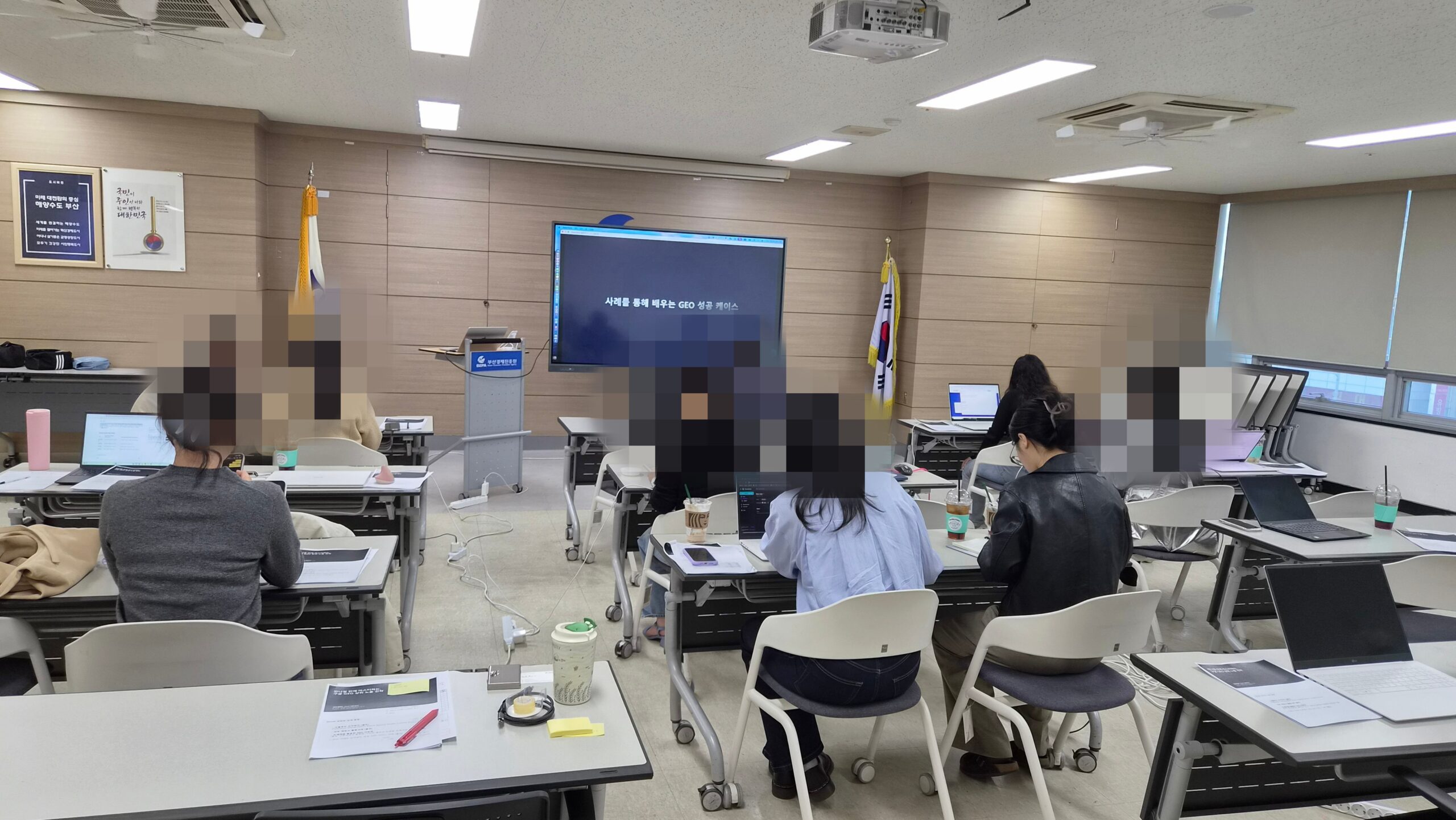
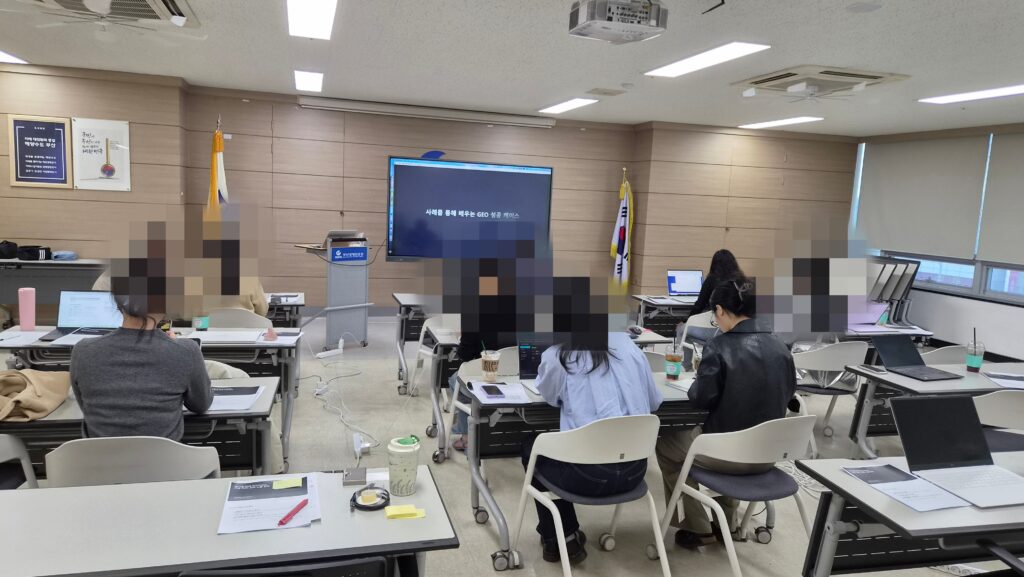
On October 22, 2026, I conducted a Google SEO & GEO one-day class for executives and marketing staff from export companies at the Busan Business Agency.
Under the theme ‘Mastering Google SEO Top Rankings in Half a Day,’ we spent about four hours covering everything from search strategies for discovering overseas buyers to responding to AI search and diagnosing company websites.
In this post, I’ll share the key points covered in the lecture and what I focused on while preparing the training.
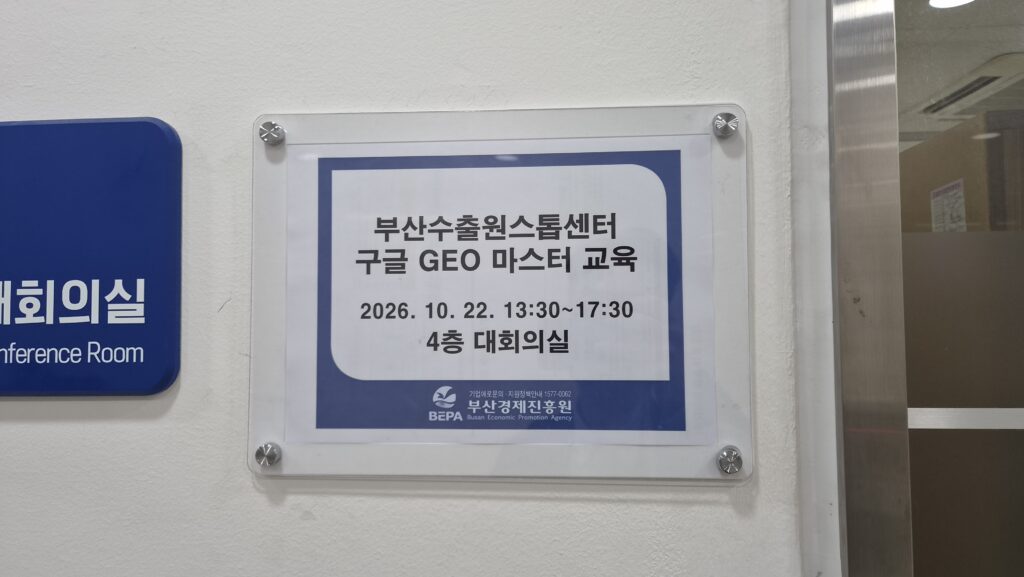
Overview of the Google SEO GEO Training at Busan Business Agency
This training was designed for about 20 executives and marketing staff from export companies preparing to enter overseas markets or already running global marketing efforts.
The core curriculum covered overseas buyer keyword research, the fundamentals of Google SEO structure, GEO (AI search visibility optimization), and a live website diagnosis.
Even within overseas marketing, each company’s goals differ.
Some companies aim to sell products directly to overseas consumers, while others want to generate inquiries from local partners or buyers. So before starting the session, I first checked each participant’s business type and experience level, then adjusted the balance of explanations and case studies accordingly.
My goal for this kind of hands-on training isn’t to cram in as many terms as possible in a short time.
It’s to help each company walk away able to decide for themselves which search terms to target and what to check first on their website.
1. Finding the Keywords Overseas Buyers Actually Search For
The first session covered why search intent matters more than search volume in Google SEO strategy.
Even for the same keyword, a search meant to gather information has a different purpose than one meant to find an actual purchase, quote, or supplier.
This is especially important for B2B export companies: rather than simply increasing website traffic, it’s more valuable to find keywords likely to lead to actual inquiries. Drawing on real consulting experience, I introduced a keyword scoring process that analyzes competitors’ search keywords and ranks them by purchase intent.
I emphasized that producing a large volume of content matters less than first defining which customer questions you’re trying to answer.
2. The Basics of Google SEO: Checking Your Website Structure
The second session looked at how websites get properly discovered and indexed by search engines.
In SEO consulting, I often find not just a lack of content, but also cases where search engines simply can’t properly access the website.
Common culprits include domain and multilingual URL structures, redirects from website redesigns, robots.txt, and sitemap.xml.
I also explained how SEO management differs depending on the website platform—WordPress, Cafe24, Imweb, Shopify, and others.
When Google SEO results fall short of expectations, the first step isn’t necessarily publishing more content—it’s checking whether search engines can properly access and index the page in question. I walked participants through this process by pulling up live websites on screen.
3. GEO Lecture: How Do You Prepare for AI Search Visibility?
GEO (Generative Engine Optimization) has become a staple topic in SEO training lately.
As more users turn to generative AI tools like ChatGPT and Gemini to find information, businesses have also started paying attention to AI search visibility.
That said, not every company needs to invest heavily in a dedicated GEO project right away.
In this lecture, I shared traffic data from a website I personally manage and explained how much AI search actually contributes to real visits and inquiries.
I also explained that GEO investment priorities can vary depending on a company’s industry and customer buying journey.
My approach is to build on solid existing SEO fundamentals and gradually expand coverage to the AI search landscape.
It’s worth starting with the basics—quality content, a website structure that’s easy for search engines to understand, and brand mentions across external channels.
We also examined technical elements, including schema markup, but we did not present it as if specific settings alone could guarantee AI search visibility.
4. Live Public Consulting on Participating Companies’ Websites
In the final session, we reviewed the websites of participants who agreed to have them shared publicly.
We discussed improvement directions tailored to each company’s situation—covering everything from search engine accessibility to content structure, keyword strategy, and inquiry conversion paths.
When analyzing real sites, big-budget overhauls aren’t always necessary.
It’s often more effective to keep what’s already working well and prioritize fixes for the elements most likely to impact performance. Rather than handing out a long checklist, I believe what matters most is leaving participants with clear priorities they can act on right after training.
For Those Preparing Google SEO GEO Corporate Training
I’ve conducted training on Google SEO, overseas buyer discovery, and digital marketing for public institutions, universities, and companies—including KOTRA and the Korea International Trade Association (KITA).
When preparing a lecture, what I pay the most attention to is the audience’s level and real-world work environment.
Even for the same SEO topic, early-stage startups and companies already active in overseas sales need different content.
When training coordinators share the participating companies’ industries, training goals, and pre-submitted questions, I use that information to adjust the difficulty level and case studies accordingly.
Here are the main types of training I offer.
Export support organizations: Overseas buyer discovery and global search marketing training
SMEs and startup support organizations: Google SEO fundamentals and hands-on training
Industry associations: AI search visibility optimization (GEO) special lecture
Marketing professionals: Website SEO audit and search traffic improvement workshop
* Depending on the training duration and audience, sessions can be structured in various formats—from case-study-focused lectures to live demos, hands-on practice, and public website consulting.